



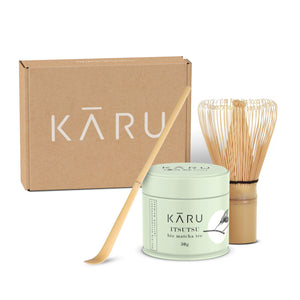


Matcha for baking and cooking turns cakes, ice cream and cookies a vibrant green without artificial coloring – but not every grade is suited to it. In short: for recipes, use a strong, affordable culinary matcha like Organic Matcha Itsutsu, not a delicate ceremonial matcha. Read on to learn why, and what to keep in mind when heating it.
Key points at a glance
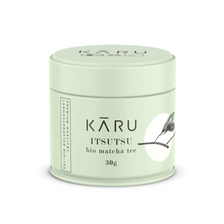
- For baking, a strong culinary or entry-level matcha works best (e.g. Organic Matcha Itsutsu, €19) – its tart aroma holds its own against sugar, flour and cream.
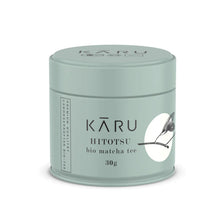
- Premium and ceremonial matcha (e.g. Matcha Hitotsu) are too good for baking: their delicate, sweet notes get lost among dominant ingredients.
- Matcha colors food through its chlorophyll alone – with no artificial coloring at all.
- The antioxidants (catechins such as EGCG) are more heat-stable than often assumed: in one study, they remained active in cake batter during baking.
- Color and aroma suffer mainly above 190 °C – lower temperatures and shorter baking times preserve the vibrant green.
Which matcha is suitable for baking and cooking?
Baking and cooking call for a strong, tart matcha – not a delicate premium tea. The reason is simple: next to dominant ingredients like sugar, flour and cream, the subtle flavor of high-quality matchas quickly gets lost. Nobody can taste the subtle, umami-rich notes you'd actually value a ceremonial matcha for in a finished cake.
Entry-level grades, on the other hand, are not only much more affordable but also more tart and intense. It's exactly this strong green color and distinctive flavor that make them ideal for recipes. At KĀRU, that's Organic Matcha Itsutsu (€19): fruity and intense, dominant in flavor and therefore perfect for smoothies, matcha lattes, cakes and ice cream.
|
Matcha |
Character |
Best for |
|
Organic Matcha Itsutsu (€19) |
fruity, intense, tart |
baking, cooking, lattes, smoothies |
|
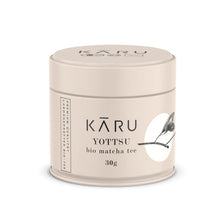
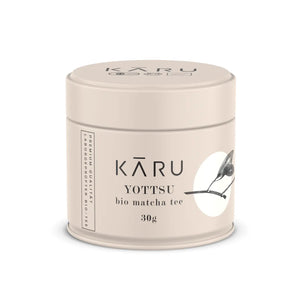
Organic Matcha Yottsu (€25) |
strong, for everyday use |
lattes, mixed drinks, recipes |
|
Matcha Hitotsu (€35) |
delicate, sweet, umami |
enjoying pure (usucha/koicha) |
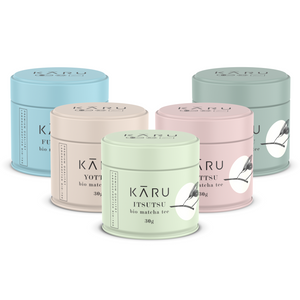
In short: the finer and more expensive the matcha, the more you should drink it pure. For baking, the stronger, more affordable powder is the way to go. We explain exactly how the quality grades differ in the article Matcha tea – grades and differences.
Are the healthy compounds preserved during baking?
For the most part, yes. Matcha provides antioxidants, vitamins and proteins – above all catechins, of which EGCG (epigallocatechin gallate) is the most important. Contrary to what's often assumed, these compounds are fairly heat-stable: in a study on reactive carbonyl compounds, the catechins from added matcha powder remained active in cake batter even during baking, where they trapped harmful compounds.
Temperature is what matters. At around 160 °C, EGCG has a half-life of about two hours, which drops sharply above 190 °C. In practice, this means: at moderate heat and normal baking times, most of the active compounds are preserved. The caffeine also survives baking almost completely – so your matcha bakes can definitely wake you up.
Two things, however, reduce the nutrient content from the outset: very high baking temperatures and the grade used. More affordable matchas are shaded for a shorter time, dried faster and ground by machine, and therefore naturally contain somewhat fewer catechins than gently processed premium teas. More on this in the article Matcha tea – nutrients.
Why not use premium matcha for baking?
It comes down to two things: flavor and appreciation. In terms of flavor, the delicate aromas of a top tea simply vanish in a cake – you just can't taste them anymore. And growing the finest matcha teas is a centuries-old tradition in Japan; the highest grades involve an enormous amount of handwork, time and experience.
Using a premium matcha for baking is therefore a bit like pouring a fine wine into tomato sauce: it works, but it gives away what makes the product special. For recipes, a strong, affordable matcha isn't the compromise – it's the better choice.
Can you still bake with old or improperly stored matcha?
Often, yes. With improper storage – exposure to light, heat and oxygen – matcha loses aroma and color intensity. It may then no longer be good enough for a pure usucha or koicha. But as long as it hasn't gone bad and is just less aromatic, a recipe is the perfect second use: the strong ingredients around it make up for the loss of aroma anyway. That way, good tea doesn't end up in the trash.
What can you bake and cook with matcha?
The focus is on sweets – cakes, ice cream, cookies, panna cotta or waffles – because this is where the vibrant green color really shines. Since you can fine-tune the flavor through the amount of matcha, the possibilities are almost endless: from subtle to strong and tart, almost any recipe works.
Dissolve the powder
Stir the matcha into a little cold milk, oil or water until smooth and free of lumps.
Fold in gently
Mix with the remaining ingredients – don't add it to boiling-hot liquid.
Bake moderately
Bake below 190 °C if possible to protect color and active compounds.
You'll find concrete ideas in our matcha recipes – from panna cotta to vegan ice cream.

Organic Matcha Itsutsu
Fruchtig-intensiver Bio-Matcha – kräftig genug fürs Backen, Kochen und Latte.
from 19,00 € , 633,33 €/kg


