





How you store your tea decides whether your matcha is still bright green, sweet and aromatic after weeks – or flat and brownish. The fine powder is more delicate than loose-leaf green tea, because grinding breaks open every cell wall and exposes the compounds directly to air, light and moisture.
The essentials at a glance
- Matcha needs to be kept away from four things: oxygen, light, heat and moisture. They drive oxidation and loss of color.
- Unopened and stored cool, matcha keeps for about a year; once opened, you should use it up within 2–3 months.
- A study by Ito En's quality control (Chagyo Kenkyu Hokoku, 2002) showed: at −70 °C hardly any loss of quality over 24 weeks, at 25 °C clear degradation after 12 weeks, at 37 °C already after 3–4 weeks – even in sealed bags.
- Opened matcha does not belong in the fridge: temperature changes lead to condensation, lumps and, in the worst case, mold.
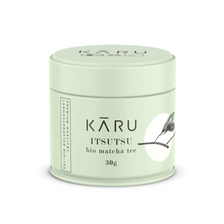
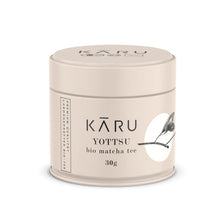
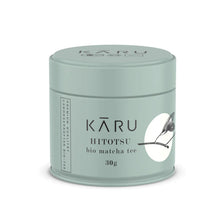
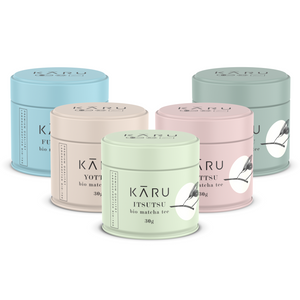
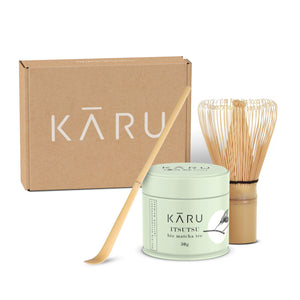
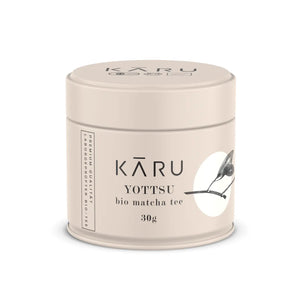
- Ideal is an airtight, opaque tin with a small fill size – such as a 30 g tea tin with a screw cap and rubber-sealed lid.
Why is matcha so delicate?
Because it is ground so extremely fine, matcha has a surface area many times larger than conventional green teas. That greatly increases its exposure to light and oxygen. On contact with air and light, the delicate powder quickly loses color, flavor and effect.
Two processes are mainly responsible. On contact with oxygen, some tea compounds oxidize – vitamin C and catechins such as EGCG (at 50–60% the most important catechin in matcha) break down. Light also breaks down the chlorophyll: the bright green turns into brownish pheophytins. Even a few minutes of direct sunlight visibly shift the color.
How do I store matcha properly – cool and protected from light?
To keep your matcha fresh for a long time, store it in a cool, dark and dry place. At low temperatures, the biochemical processes slow down and natural decomposition is delayed. That is exactly what the Ito En study confirms: below 4 °C, sealed matcha stays stable; above 25 °C, it quickly loses quality even in a closed bag.

So a fridge sounds ideal at first – but there's a catch. Unopened, cool storage is no problem. Opened, it becomes a risk: the temperature difference between fridge and room makes water condense in the tin or bag. This moisture makes the matcha clump and, in the worst case, can encourage mold.
Which packaging protects matcha best?
Even the best storage won't help if the packaging isn't suitable. What matters is that the tin or bag closes completely airtight again after opening. The bags from Matcha Kāru can be resealed airtight after opening.
With tins, it's worth looking at the closure: a screw cap with a rubber seal on the lid or an additional inner lid are good. The fill size counts too: you'll hardly finish a tin that's too large before the quality suffers. That's why our green teas are sealed in 30 g tea tins with a reliable screw cap and rubber-sealed lid – tight against oxygen and moisture.
Airtight
Choose a screw cap with a rubber seal or an inner lid.
Lightproof
An opaque tin instead of glass – light bleaches the green.
Small
Better a small fill size, so you use it up quickly.

Japanese decorative tins have proven particularly reliable: in addition to the slip-on lid, they have an inner lid and so seal the tea as well as possible. They are also a stylish part of the Japanese tea ceremony: neutral in taste, easy to fill and with a classic pattern. Traditionally, tencha for the tea ceremony was already kept in airtight ceramic and lacquer containers.
How can I tell if matcha has gone bad?
If matcha is stored incorrectly, it quickly loses character and flavor. As with the quality differences in matcha, it's mainly color, smell and taste that tell you whether the powder is still fresh. If you already have more experience with matcha, you'll notice right away – as a beginner, these three signs will help you.
Feature |
Fresh matcha |
Spoiled matcha |
Color |
Bright, rich green |
Dull, yellowish to brownish |
Smell |
Sweet, fresh and grassy |
Musty or odorless |
Taste |
Slightly sweet, rich in umami |
Bitter or bland |

How long does matcha keep?
Unopened tins, stored cool and dry, keep for about a year without any noticeable loss of quality. Once opened, you should use matcha up within two to three months so it keeps its best qualities. The longer the tin is open, the more aroma and bright green are lost – another reason to choose a smaller fill size.

Organic Matcha Mittsu
Everyday-Matcha in der luftdichten 30-g-Dose mit gummiertem Drehverschluss
from 27,00 € , 900,00 €/kg


