



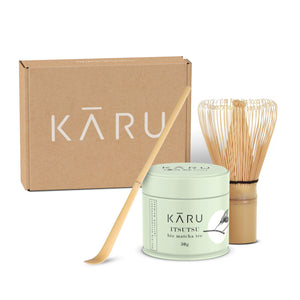


Usucha and koicha are the two classic ways of preparing matcha: usucha (薄茶, "thin tea") is whisked until frothy, koicha (濃茶, "thick tea") is stirred into a viscous paste. The difference lies mainly in the ratio of powder to water – and in the matcha quality you need for each.
The essentials at a glance
- Usucha ("thin tea"): approx. 1.5–2 g of matcha to 60–80 ml of water, whisked until frothy with the chasen. The lighter, everyday preparation.
- Koicha ("thick tea"): approx. 3.5–5 g of matcha to 20–40 ml of water, gently stirred into a paste – with a consistency like melted chocolate.
- Koicha is around four to five times as concentrated as usucha and therefore needs first-class matcha; cheaper grades taste bitter.
- For both, the water temperature is 75 °C at most, otherwise the tea turns bitter.
- The phrase "suitable for koicha" is a sign of quality: only mild, umami-rich grades pass the koicha test.
The note "suitable for koicha" appears in the description of many high-quality matcha grades. But what do koicha and usucha actually mean – and how do the two differ? That's exactly what we explain here.
What is the difference between usucha and koicha?
Usucha and koicha describe two different ways of preparing matcha. Usucha translates as "thin, light tea", koicha as "heavy, dark tea". The name refers to the intensity and concentration of the tea. For usucha, you mix 60–80 ml of water with 1.5–2 g of matcha; for koicha, 20–40 ml of water go with 3.5–5 g of powder.
As a result, the two have a completely different consistency. Usucha is reminiscent of a cappuccino or strong espresso, koicha more of melted chocolate or liquid honey. In Japan, people say you "chew" koicha rather than drink it – which captures the thick texture pretty well.
Feature |
Usucha (薄茶) |
Koicha (濃茶) |
Meaning |
"thin tea" |
"thick tea" |
Matcha |
1.5–2 g |
3.5–5 g |
Water |
60–80 ml |
20–40 ml |
Consistency |
light, frothy |
viscous, paste-like |
Technique |
whisk quickly until frothy |
stir gently |
Quality |
all good grades |
premium quality only |
Occasion |
everyday |
ceremony, special moment |
How does preparing usucha differ from koicha?
Besides the amount of powder and water, the main difference is the way you stir. For thin usucha, you move the chasen through the bowl in quick W-shaped movements to whisk the tea until frothy. Koicha, on the other hand, is stirred gently rather than whisked – until a smooth, even paste forms.
Sift
Sift the matcha into the bowl so no lumps form.
Mix
Add a little water (max. 75 °C) and stir into a smooth paste.
Finish
Usucha: more water, whisk until frothy. Koicha: just a little water, keep stirring gently.
So preparing thick koicha closely resembles the first phase of classic matcha preparation, in which an even paste is mixed first. You'll find detailed instructions in our article on how to prepare matcha properly.

Why does koicha need a higher matcha quality?
Because of its very high concentration, koicha tastes much more intense than usucha. Even the finest flavor notes come through – which is why the best teas are traditionally tasted as koicha. Only this concentrated form allows a precise characterization. The downside: unpleasant notes such as acidity and bitterness also stand out more clearly.
For this reason, we recommend preparing only the highest-quality teas as koicha. With cheaper entry-level grades, the bitter notes otherwise dominate. Only true premium grades still impress in concentrated form with a sweet, complex character and full umami. Traditionally, shade-grown teas from the first harvest are suited to koicha, such as those from the well-known growing region of Uji.


Organic Matcha Hitotsu
Premium-Qualität aus Uji – mild, umami-reich und ideal für Koicha.
from 35,00 € , 1.166,67 €/kg
Which bowl suits usucha and koicha?
Besides the bamboo whisk (chasen) and the bamboo spoon for measuring the right amount, the right bowl also helps with both ways of preparing matcha.
The right bowl for usucha
For usucha, the thinner and lighter version, wide, shallow tea bowls work best. They give the tea room to spread out freely and develop its aromas, and offer enough space to whisk a light, airy layer of foam with the chasen.
The right bowl for koicha
For thick koicha, deeper, narrower tea bowls are recommended. They preserve intensity and fullness of flavor, because the tea has less surface area to evaporate from.

The quality of the bowl matters too: it should appeal to both the touch and the eye, because appreciation for the tea is also expressed through the beauty of its vessel.
Usucha or koicha – which should you choose?
Whether you prepare your tea with more or less water is ultimately a matter of taste. In Japan, it's common to prepare the best grades as koicha and share one bowl among several people. In Europe, koicha is still the exception – even really good teas are mostly drunk as usucha here.
Our advice: don't worry too much about rules or labels, just prepare the tea the way you like it best. Simply try different concentrations and compare them to find your personal favorite. As long as the matcha quality is right, you can't go wrong. And if you like it creamy, the matcha latte is also an easy, modern alternative.


