





Matcha caffeine works differently from coffee caffeine: one bowl made with 2 g of powder provides around 28 to 70 mg of caffeine, depending on quality – together with the amino acid L-theanine, which smooths out the kick. The result is calm alertness over several hours instead of a peak and a crash.
Key points at a glance
- A standard bowl of matcha (2 g of powder, 70 ml of water) contains 28 to 70 mg of caffeine, depending on quality – a cup of filter coffee comes in at around 95 to 100 mg.
- In 2024, the Bavarian State Office for Health and Food Safety (LGL) tested 47 matcha samples from retail: the caffeine content ranged between 14 and 36 mg per gram of powder.
- Coffee beans contain only about 10 to 12 mg of caffeine per gram – so per gram, matcha is much higher in caffeine, but not per cup, because you use 2 g of matcha instead of 12 g of coffee.
- L-theanine occurs almost exclusively in Camellia sinensis. Analyses have measured up to 44.65 mg per gram of matcha powder; three weeks of shading before the harvest prevents it from breaking down.
- In a double-blind study by Giesbrecht et al. (2010), the combination of 97 mg of L-theanine and 40 mg of caffeine improved task-switching accuracy in 44 participants and reduced feelings of tiredness.

How much caffeine is really in matcha?
Per gram, matcha contains considerably more caffeine than coffee. Depending on the grade and harvest time, matcha ranges between 20 and 45 mg per gram, about 35 mg on average. Coffee beans come to around 10 to 12 mg per gram.
What matters, though, is the dose. For a bowl of matcha you use 1 to 2 g of powder; for a cup of filter coffee, around 12 g of beans are brewed. In the end, both drinks land in a similar range – matcha often even slightly below.
|
Drink |
Amount |
Caffeine per serving |
|
Matcha (usucha) |
2 g powder to 70 ml |
approx. 28–70 mg |
|
Matcha (koicha) |
3–4 g powder to 30 ml |
approx. 70–140 mg |
|
Filter coffee |
approx. 12 g beans to 200 ml |
approx. 95–100 mg |
|
Espresso |
approx. 8 g to 30 ml |
approx. 60–80 mg |
There is a concrete reason for this range: the caffeine content varies with harvest time, grade and growing region. That is why hardly any matcha tin states a caffeine value. The 2024 LGL study of 47 retail samples showed a range of 1.4 to 3.6 g of caffeine per 100 g of dry matter.
Why does matcha caffeine feel gentler than coffee?
The difference lies not in the amount but in what comes with it. Alongside caffeine, matcha brings the amino acid L-theanine, which occurs almost exclusively in the tea plant Camellia sinensis. Analyses of matcha powder have measured up to 44.65 mg of L-theanine per gram.
This high content comes from shading: three to four weeks before the harvest, the tea plants are covered. This prevents theanine from breaking down in the young shoots – and at the same time raises the chlorophyll content, which gives matcha its bright green color.
What the combination does in the body is well researched. In 2010, Giesbrecht et al. tested 44 young adults in a double-blind, placebo-controlled study: 97 mg of L-theanine plus 40 mg of caffeine significantly improved task-switching accuracy and self-rated alertness, while feelings of tiredness decreased. Rogers et al. (2008) also showed that L-theanine dampens the blood-pressure-raising effect of caffeine.
In practice, this means: studies suggest that the energy builds more slowly, lasts for about four to six hours and ends without the typical slump. If coffee tends to make you jittery or gives you heart palpitations, you often tolerate matcha better – although this varies from person to person and is no guarantee.

How does coffee compare?
Coffee caffeine is absorbed quickly and reaches its highest concentration in the blood after about 15 to 45 minutes. In the brain, it blocks the adenosine receptors – the docking sites the body uses to signal tiredness. Alertness rises correspondingly fast.
This very steep rise has a downside. In larger amounts, caffeine can cause nervousness, trembling and restlessness. When the level drops again, many people feel a noticeable energy slump. On top of that, coffee's acidic pH can irritate sensitive stomachs.
Fast rise
Coffee peaks after 15–45 minutes.
Short high
High alertness, but often with restlessness.
Drop
The level falls, and the slump follows.
Matcha goes through the same three phases – just flatter and more drawn out. That is the whole difference, and it comes down to L-theanine.
How much matcha a day is safe?
The EFSA considers up to 400 mg of caffeine per day safe for healthy adults. That corresponds to about three to five bowls of matcha, depending on dose and quality.
For pregnant and breastfeeding women, the recommendation is a maximum of 200 mg per day – around two to three bowls. If you are pregnant or taking medication, check with your doctor. More on this in the article Matcha during pregnancy.
Matcha or coffee – which suits you better?
Both drinks have their place. If you need a quick, intense boost in the morning, coffee is the uncomplicated choice.
Matcha shows its strengths where you want to stay focused for several hours: a long work block, a study session, a morning without a slump. Then there is the ritual – whisking with the chasen takes two minutes and, for many, is part of the effect.
The two also differ clearly in taste: high-quality matcha from growing regions such as Uji, Nishio or Shizuoka brings a soft umami with a light astringency. If you like it creamier, the matcha latte recipe has the version with frothed milk.

In the end, it is not an either-or question. For many, coffee is the quick pick-me-up in the morning and matcha the calm companion for the rest of the day.

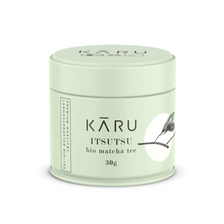
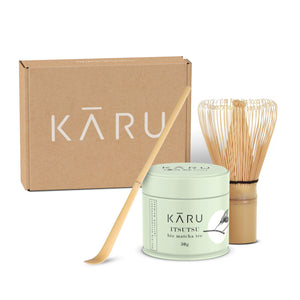
Organic Matcha Itsutsu
Beschatteter Ceremonial-Matcha mit hohem L-Theanin-Anteil – sanft im Koffein-Effekt.
from 19,00 € , 633,33 €/kg
Which matcha is right if you are sensitive to caffeine?
If you are sensitive to caffeine: start with 1 g per bowl instead of 2 g. That halves the amount of caffeine, and you still keep the full L-theanine ratio, because both substances are in the same powder.
Also choose shaded matcha in ceremonial grade. It provides more L-theanine than culinary grade – and that is exactly the substance that smooths out the caffeine spike. What else to look out for is covered in the article Finding the right matcha.
Conclusion
Matcha and coffee are closer in caffeine than many people think – around 28 to 70 mg per bowl compared with 95 to 100 mg per cup of filter coffee. The noticeable difference comes from L-theanine, which stretches and smooths the effect. If you are looking for calm focus over hours rather than a quick kick, matcha is the better fit.


