







Even the best tea in the world will not win you over if it is not prepared correctly. The preparation of matcha usually seems (too) complicated at first contact - "How am I supposed to whisk the tea with a bamboo whisk?" - However, it is much easier than you think.
Learn how to make a creamy bowl of matcha with a few tips and a few minutes of practice that will make you and any of your guests who are new to matcha an instant fan.
Matcha preparation - at a glance
To prepare a portion of matcha tea, mix 1-2g of matcha powder in a bowl with a dash of water to form a paste. Then add 75-100 ml of water (75-80 °C) and stir.
Our three most important tips:
- 1-2g matcha equals 1-2 bamboo spoons or 1/2 teaspoon.
- You can adjust the amount of water to your taste. Please noteThe more water you use, the more difficult it will be to stir the tea until frothy.
- No thermometer to hand? If you boil water and then leave it to stand for 5 minutes, the temperature will be around 80°C.
You can prepare matcha in two ways: the traditional way (our recommendation) and the quick way. The two preparation methods differ mainly in the accessories used.
Matcha tea - the traditional preparation
There are now all kinds of instructions for preparing matcha tea quickly and easily. However, we don't want to focus on speed, but on quality.
Sometimes it just has to be quick. However, be careful with tips such as: "Just pour hot water over it and stir with a spoon - done". This may be quick, but it has little to do with proper preparation. You should also steer clear of low-priced drugstore products and pay attention to the quality of the matcha itself. content content.
In this article, we will focus primarily on traditional preparation, i.e. on techniques that can be found in Japan have been tried and tested in Japan for centuries and are still practised today. With a matcha set, you have all the accessories to hand and can easily prepare matcha in the traditional way.
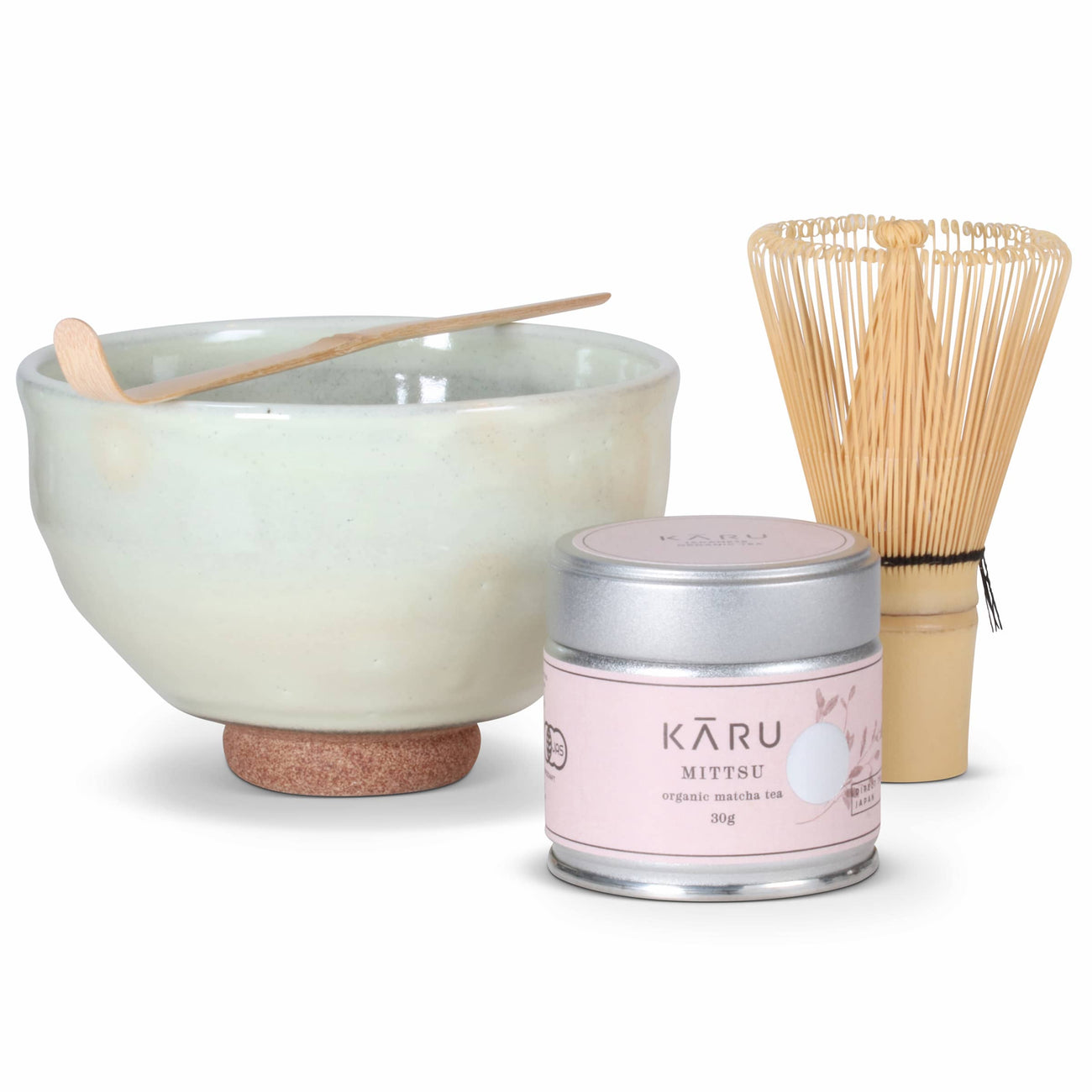 |
Matcha set Mittsu Perfect for the traditional preparation of matcha |
1. matcha tea preparation - the right matcha accessories
You don't need much to prepare matcha properly
- High-quality matcha, preferably in organic quality
- Matcha bowl for preparation and also for drinking from
- Bamboo whisk for frothing
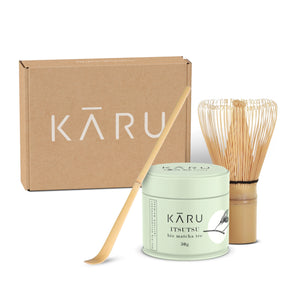
With a Matcha set from KĀRU, you get all the ingredients in one easy package.
Optional (We recommend this, but it is not mandatory):
- Matcha strainer to remove lumps (due to humidity etc.)
- Bamboo spoon for precise dosage
- Broom holder for storing the broom
You can even improvise with many things (e.g. bowl and spoon). What you should not do without, however, is the Chasen (bamboo broom). This is essential for correct preparation, as it is the only way to achieve the perfect foam. More about the Matcha accessories can be found in our article.

2. matcha tea preparation - preparatory steps
Before we start with the actual tea ceremony, a few preparatory steps are necessary.
Fill the bowl in which the tea is to be brewed with warm water and place the chasen (whisk) in the water bath. This will bowl is warmed up and the bristles of the broom are soft and elasticwhich increases the longevity of the broom.
Now pass 1 - 2 grams of the tea (1-2 bamboo spoons) through a fine sieve. sieve directly into the preheated bowl. Particularly high-quality matcha is so finely ground that the powder clumps easily due to the electrostatic forces. Sieving gives you a homogeneous powder, which is then easier to stir and forms a nice foam.

3. matcha tea preparation - a fine paste
Pour a sip of cold water over the matcha. Mix the powder with the water to form a homogeneous, lump-free paste. Traditionally, the chasen (broom) is only used by thumb and forefinger finger. To get started, however, you should simply hold the broom in the way that is most comfortable for you. Make sure you don't work with too much pressure to protect the broom. It's not about speed, just about creating a smooth paste.
4. matcha tea preparation - the infusion
As a guide, you should add approx. 50 ml of water to one gram of matcha. But of course this depends primarily on your preferences. Some people like to drink their tea very thick and intense (koicha), others like it milder and use a correspondingly more water (usucha). You can find out more about the different types of preparation in the article: Different types of preparation.
The temperature is important. The water must never boil when pouring over the tea, as this would make the tea bitter. The ideal temperature is temperature between 75 and 80 °C is ideal. This is when the subtle aromas develop best.
Add the water to the tea and stir the liquid with quick W-shaped movements into a frothy matcha. When doing so, guide the tips of the whisk just below the surface of the water; the bristles should not touch the bottom of the bowl. At the end, there should be no lumps left in the bowl and a dense and fine foam should have formed.

If the foam is not quite right at the beginning, this is completely normal. It simply takes a little practice to move the whisk in such a way that the tea forms a respectable head.
5 Clean the accessories
After use, clean the matcha whisk with water (please do not use washing-up liquid) and either place it on a dry cloth or on a broom holder broom holder. A holder allows the Chasen to keep its shape for longer and dry well.

Matcha tea - quick preparation
If you need something quicker, we have the following tips for preparing matcha quickly:
- Use an electric milk frother instead of a whisk
- Use a shaker or glass with a lid -> the matcha is shaken rather than stirred
Can matcha tea also be drunk cold?
Yes, definitely! Matcha tea can also be enjoyed cold. Cold matcha tea is a refreshing drink. alternative to the hot version and particularly popular in the warmer months. The Preparation of a cold matcha tea is almost as easy as the hot version, with the additional step of cooling.

If you prefer to enjoy your matcha non-traditionally with milk, it is best to use matcha with a strong aromalike the Matcha Itsutsu or the Matcha Yottsuso that the full-bodied taste is not masked by the (plant) milk. Especially for matcha latte Bowls with a spout for a precise end result.
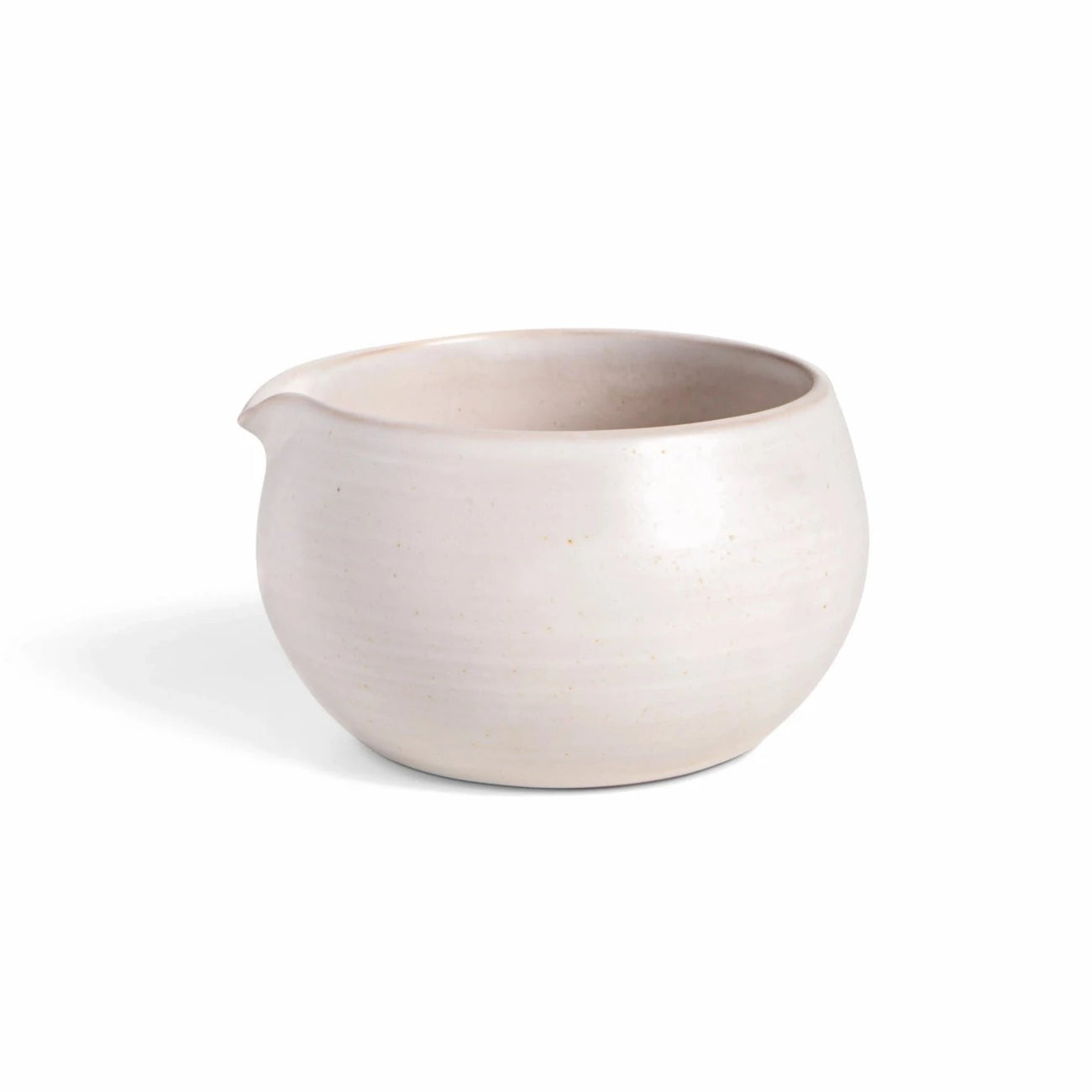 |
Bowl (Chawan) Miruku A bowl for matcha latte connoisseurs, perfect for sharing |
Conclusion - preparing matcha tea the traditional way
As you can see, matcha tea is quick and easy to prepare, yet still traditional way traditional way. All you need is a bamboo whisk, a little practice and, of course, the right matcha powder.


