



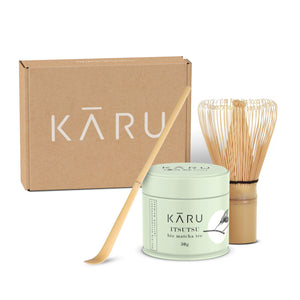


Matcha accessories range from indispensable to purely aesthetic – and knowing the difference saves you money and frustration when you buy. This overview shows you which four tools you really need for a good matcha and which pieces are simply nice to have.
Key points at a glance
- Only three utensils make up the basic equipment: bamboo whisk (chasen), bamboo spoon (chashaku) and matcha bowl (chawan). Everything else is optional.
- The chasen is the only truly indispensable tool. It is carved from a single piece of bamboo and, depending on the style, has 70–120 bristles.
- Origin: Around 90% of all Japanese bamboo tea utensils come from Takayama (Ikoma City, Nara Prefecture) – the center of chasen making for more than 500 years.
- Golden vs. dark bamboo differ only in appearance: quality and durability are identical; dark bamboo is just rarer and therefore more expensive.
- A sifter (furui) breaks up lumps before whisking and makes the matcha creamier – an inexpensive but effective extra.
For classic matcha preparation, a modest set of tools is enough. We go through them in the order you use them when preparing matcha – from sifting to measuring to whisking – and tell you for each one whether it is a must or nice to have.
Which matcha accessories do you really need?
Traditionally, three utensils form the basic equipment: the bamboo whisk (chasen), the bamboo spoon (chashaku) and the matcha bowl (chawan). With these you can prepare any matcha properly. A sifter, whisk holder and tea caddy improve the result, handling or storage – but they are not necessary.
|
Utensil |
Japanese name |
Necessity |
Function |
|
Bamboo whisk |
Chasen (茶筅) |
Indispensable |
Mixes and froths the matcha |
|
Bamboo spoon |
Chashaku (茶杓) |
Basic equipment |
Measures the powder |
|
Matcha bowl |
Chawan (抹茶椀) |
Basic equipment |
Vessel for preparing and drinking |
|
Sifter |
Furui (篩) |
Optional |
Breaks up lumps for a creamy texture |
|
Whisk holder |
Kusenaoshi |
Optional |
Dries the chasen while keeping its shape |
|
Tea caddy |
Natsume (棗) |
Optional |
Stores matcha protected from light and air |
Why is the bamboo whisk (chasen) indispensable?
The chasen is the most important and the only truly indispensable tool. Handmade from a single piece of bamboo, this utensil cannot be replaced by anything in traditional preparation. Depending on the style, the whisk has between 70 and 120 bristles, which are used to mix and froth the tea.
The art of chasen making has its origins in Takayama in Japan's Nara Prefecture, where whisks have been made using traditional techniques for more than 500 years. To this day, around 90% of all Japanese bamboo tea utensils come from there. The bamboo whisk dates back to the Muromachi period (roughly 1336–1573); the tea master Murata Jukō is considered an early pioneer.
A detail that affects the taste: a metal whisk would impair the delicate aroma of the matcha – which is why bamboo remains the material of choice. How to care for and use your chasen properly is explained in our guide to preparing matcha.

Which chasen suits usucha and koicha?
The more bristles a chasen has, the more easily and finely the tea can be whisked. But the style also determines the type of tea:
Usucha (thin)
Delicate whisks with many fine bristles whip the light, thin matcha into an airy froth.
Koicha (thick)
Whisks with fewer, sturdier bristles cope better with the viscous, thicker matcha.
You can learn more about the difference between the two styles of preparation in our article Usucha and koicha. When it comes to material: golden and dark bamboo differ only aesthetically – quality and durability are identical. Dark bamboo is simply rarer, which explains the higher price.
What do you need the bamboo spoon (chashaku) for?
The chashaku is used to scoop and measure the matcha powder. Because the electrostatic adhesion of wood is lower than that of metal, less fine powder sticks to a bamboo spoon than to a metal spoon – so measuring is cleaner. Together with the chasen and chawan, it makes up the traditional basic equipment. As with the whisk, it comes in golden and dark bamboo.
What makes the matcha bowl (chawan) special?
Now for the artistic part of the accessories: the chawan. It is not strictly necessary – in principle, any bowl with a suitable shape and enough size will do. But a real chawan made with Japanese craftsmanship gives the preparation a completely different feel.
The slightly uneven surface and the often expressive decoration give every bowl its own character. You can see at once that these are handmade, one-of-a-kind pieces, not mass-produced goods. A chawan is therefore not just a drinking vessel but always a piece of art as well. For matcha latte or for dividing among several cups, there are also bowls with a spout.

Do you need a matcha sifter (furui)?
It is not a must, but it is worth it: if matcha is finely sifted before whisking, the small lumps break up and the powder becomes even again. The tea then mixes faster and more evenly and turns noticeably creamier.
Outside Japan, a fine kitchen sieve is often used; in Japan, special sifter inserts for matcha tins are used, through which the powder is pressed straight into the tin with a small spatula – so you have sifter and container in one. By the way, we explain why a stainless steel sifter does not harm the aroma in our fact check Matcha vs. metal.
Which accessories are optional?
Two more pieces are practical, but nice to have.
The whisk holder (kusenaoshi) is used to store the chasen: on the holder, the whisk dries quickly and keeps its shape – which noticeably extends its life. The tea caddy (natsume) stores matcha protected from light and air. Because these often handmade containers are decorated as artfully as the bowls, they are an aesthetic alternative to ordinary aluminum tins.


Matcha Whisk – Dark Bamboo (100 Bristles)
Der unverzichtbare Chasen – handgefertigt aus dunklem Bambus mit 100 Borsten.
17,00 €
Conclusion: what should you start with?
To get started, you need exactly three things: a chasen, a chashaku and a chawan. A sifter makes the matcha creamier; a whisk holder and tea caddy extend lifespan and freshness. Everything beyond that is a matter of personal taste – and of the joy of Japanese craftsmanship.


