





The Japanese tea ceremony is far more than making tea: it is a choreographed ritual that for centuries has brought together mindfulness, hospitality and the aesthetics of wabi-sabi in a single bowl of matcha. Here you'll get a clear look at its sequence, rules and meaning.
Key points at a glance
- The Japanese tea ceremony is called Chadō / Sadō ("Way of Tea") or Chanoyu ("hot water for tea").
- It is based on four principles of tea master Sen no Rikyū (1522–1591): Wa (harmony), Kei (respect), Sei (purity) and Jaku (tranquility).
- The tea served is usually matcha – as thin usucha or thick koicha.
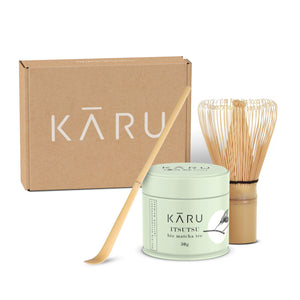
- The central utensils are the chawan (tea bowl), chasen (bamboo whisk), chashaku (tea scoop) and natsume (tea caddy).
- In 1191, the monk Eisai brought matcha preparation and tea seeds from China to Japan – the origin of the ceremony.
What is the Japanese tea ceremony?
In the tea ceremony, a host receives one or more guests to serve them tea and a small meal according to fixed rules. It's not about simply drinking, but about a shared experience of calm, aesthetics and mutual respect.
The same ritual goes by several names. Chadō (also Sadō) literally means "Way of Tea" and emphasizes the philosophical, spiritual dimension. Chanoyu means "hot water for tea" and refers more to how it is carried out in practice. Exactly how a ceremony unfolds also depends on the school, the season and time of day, and the occasion.
Where does the tea ceremony come from?
Its roots lie in Zen Buddhism. In the early Kamakura period, the Zen monk Eisai (1141–1215) brought tea seeds and the method of preparing matcha from China to Kyoto in 1191. The tea drinking of the monasteries developed into a fixed ritual.
In the 15th and 16th centuries, tea masters such as Murata Jukō and Takeno Jōō developed the ceremony further. It was finally Sen no Rikyū who gave it the form that still shapes it today: he placed simplicity rather than splendor at its center and founded the aesthetics of wabi-sabi – the beauty of the simple, the natural and the transient.
Which four principles define the Way of Tea?
Sen no Rikyū established four basic principles that run through every ceremony – from the greeting to the last sip:
| Principle | Japanese | Meaning |
|---|---|---|
| Harmony | Wa (和) | Accord between guests, utensils and nature, including the season. |
| Respect | Kei (敬) | Regard for people and objects; hierarchies step back. |
| Purity | Sei (清) | Outer and inner cleansing – shedding the "dust of everyday life". |
| Tranquility | Jaku (寂) | Inner calm and reflection that arise from practicing the first three principles. |
If you'd like to go deeper, you'll find more in our article on the four principles of the Way of Tea.
How does a Japanese tea ceremony unfold?
The sequence is precisely defined. Even though details vary by school, a complete ceremony usually follows these stages:
Arriving in the garden
The guests walk along the roji (garden path) and leave everyday life behind.
Cleansing
At a stone basin, guests wash their hands and rinse their mouths; shoes stay outside.
Entering the tea room
After five strikes of the gong, guests pass through the low crawl-through entrance into the chashitsu – a sign of equality and humility.
Kaiseki & taking your seat
At long ceremonies, a light meal (kaiseki) is served; guests sit in seiza, kneeling on their heels.
Once everyone is gathered, the actual core begins: preparing the tea. In front of the guests, the tea master cleans each utensil with the silk fukusa, heats the water in the iron kettle (kama) and whisks the matcha until frothy with the bamboo whisk (chasen).
The prepared tea is first served to the main guest, who accepts the bowl with a bow. Before drinking, each guest turns the chawan twice clockwise so that the most beautiful side of the bowl does not face their own mouth. The tea is drunk in several sips, the last one audibly. Then you wipe the rim of the bowl and pass it on.
Which utensils are used?
Every utensil (Japanese dōgu) has its fixed role. The most important pieces:
| Utensil | Japanese | Function |
|---|---|---|
| Tea bowl | Chawan (茶碗) | Handmade, often matched to the season: wide for summer, tall and narrow for winter. |
| Bamboo whisk | Chasen (茶筅) | Carved from a single piece of bamboo, with dozens of fine tines for frothing. |
| Tea scoop | Chashaku (茶杓) | Slender bamboo scoop used to portion the matcha. |
| Tea caddy | Natsume (棗) | Container for thin tea (usucha); for thick tea, the cha-ire is used. |
| Kettle | Kama (釜) | Iron kettle for heating the water. |
Incidentally, there isn't one single "ceremonial matcha" – depending on the occasion, thin usucha or thick, intense koicha is served. We explain the difference and the right preparation in our article Usucha and koicha.
Can you experience a tea ceremony yourself?
Yes. In Japan, alongside the formal ceremonies lasting several hours, shorter, simplified versions are also offered – well suited to visitors in particular. But there are opportunities in Germany too, for example in the Japanese Garden in Hamburg. And if you like, you can recreate the basic idea at home: whisk matcha mindfully, pause for a moment, enjoy it consciously.
Our guide to preparing matcha the right way shows you how, step by step.

Organic Matcha Hitotsu
Schattengewachsener Bio-Matcha aus Uji – ideal für einen milden Usucha.
from 35,00 € , 1.166,67 €/kg
Conclusion
The Japanese tea ceremony combines clear rules with deep calm: the sequence, the utensils and the four principles Wa, Kei, Sei and Jaku all serve the same goal – sharing a moment of complete mindfulness over a bowl of matcha. Whether as an onlooker in Japan or with your own chasen at home: the Way of Tea begins with the first mindful sip.


