





When it comes to matcha prices, the range runs from a few euros per 100 g pack to several euros per gram. Why the differences are so large – and how you can tell whether a price is fair – is what this article explains.
Key points at a glance
- The price of matcha is determined by four factors: origin, cultivation, harvest and processing.
- Good matcha in small pack sizes costs at least 60 cents per gram – anything much cheaper is a warning sign.
- For real matcha, the tea plant is shaded for several weeks before the harvest. This tea is called tencha, and it takes a lot of time and money to produce.
- High-quality matcha is ground on granite stone mills – only 30–40 g per hour. Industrial jet mills manage several kilos, but heat the tea strongly in the process.
- Chinese matcha is usually cheaper because shading, hand-picking and gentle grinding are often skipped.
What determines the price of matcha?
The quality – and with it the price – depends on four main factors: origin, cultivation, harvest and processing. Each of these steps can be done carefully and at great cost, or quickly and cheaply. That is exactly why prices vary so enormously.
What role does origin play?
Even though matcha has its roots in China, the best matchas today come exclusively from Japan. While traditional cultivation was forgotten in China over the centuries, in Japan it has been cultivated and refined for more than 800 years.
In China, cultivation was only taken up again with the sharp rise in demand in recent years. The focus there is on speed and quantity, not tradition. That explains a large part of the price difference between Japanese and Chinese tea.

Why is cultivation so expensive?
The secret of the full, sweet flavor lies in the special way it is grown. Unlike ordinary green tea, the plants are almost completely shaded for several weeks before the harvest. Deprived of light, the plant produces more chlorophyll and amino acids – the basis for color and umami.
This shaded tea is called tencha and is considered the finest green tea in the world. Its demanding cultivation takes a lot of time and money, and that shows directly in the price. In China, shading times – if there are any – are kept as short as possible.
To produce large quantities quickly, pesticides and chemical fertilizers are sometimes used there. Since regulations are more lax than in Japan, you should always look for an organic seal on Chinese tea.
How does the harvest affect the price?
For the best matcha, only the youngest and finest leaves are picked by hand – ideally just the top two. These are also the smallest leaves, so they yield little powder. Older leaves develop more bitter compounds and lower the quality.
In Japan, top teas are strictly selected. In China, by contrast, much of the plant ends up in the tea, and harvesting is done by machine over large areas. This makes it possible to offer large quantities at low prices – at the expense of quality.

What happens during processing?
After the harvest, the leaves are briefly steamed and dried. The short steaming stops fermentation and preserves the delicate compounds. Drying at around 180 °C produces the raw tea “aracha”. If the leaves are heated too much, color, aromas and compounds are lost.
Good teas are then sorted into grades; leaf veins and stems are removed so that only the tender leaf flesh remains. With lower-quality tea, this labor-intensive step is often skipped.
Grinding |
Output |
Result |
Granite stone mill (traditional) |
approx. 30–40 g / hour |
gentle, very fine, rich in compounds |
Jet mill / industrial ceramic mill |
several kilograms / hour |
high frictional heat, tea partly burnt, coarser |
The stone mills, made by trained stonemasons, grind much finer than industrial mills. The traditionally produced powder is therefore not only richer in compounds but also finer – another reason for the higher price.
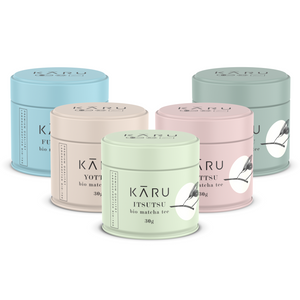
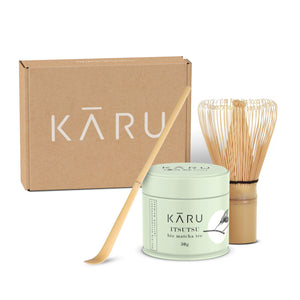
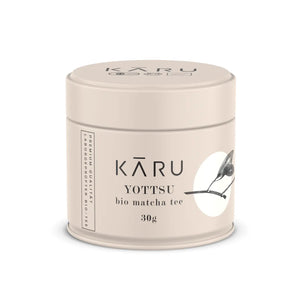
All matcha grades from Matcha Kāru come exclusively from Japan, are organically grown and lab-tested. How quality levels differ in detail is explained in the article Matcha tea – qualities and differences.
How do I recognize a fair price and good quality?
When buying online, you can judge quality by concrete points, even before you hold the tea in your hands:
Check the origin
A clear statement of growing region and origin (Japan) instead of vague “Far East” wording.
Organic & lab-tested
Organic certification and lab tests, for example for radioactive contamination and pollutants.
Put the price in context
At least approx. 60 cents per gram for small packs. Much cheaper? Best to stay away.
Use your senses
Intense green color, fine texture, fresh smell, full-bodied flavor.
Which matcha suits your needs and how much you should actually spend is also covered in the guide Finding the right matcha.
Conclusion – quality has its price
The price of matcha reflects the effort behind it: shading, selective hand-picking and gentle grinding on stone mills take time and experience. Where these are skipped, the price drops – but so does the quality. A fair price from around 60 cents per gram is therefore not a markup, but the lower limit for real, high-quality matcha from Japan.


