





Tasting matcha means judging a tea's quality step by step with your eyes, fingers, nose and palate. As with wine, a careful tasting tells you more about quality and character than any packaging – and with a little practice, you'll quickly recognize what makes a truly good matcha.
Key points at a glance
- A matcha tasting follows four steps: color, texture, aroma and flavor – ideally in that order.
- Good matcha shows a fresh, vibrant green; a yellow, brown or gray tinge points to inferior quality, improper storage or age.
- With a particle size of around 5–10 μm, premium matcha is extremely fine and feels soft like a veil, not sandy.
- Judge aroma and flavor in three forms – as powder, as paste and as finished tea.
- For usucha, whisk 1 g of matcha to 50 ml of water; for koicha, double or triple the amount of powder to bring out the finest nuances.
As with good wine or whisky, matcha comes in an almost endless range of qualities, aromas and subtle flavor nuances. A tasting is therefore not just an experience for the senses but a necessary step in determining a tea's quality and character. Like all professional tastings, the matcha test follows a fixed sequence. Let's get started.
How do you judge the color of matcha?
In the first step, you get an impression of the color. Put each matcha in a small glass container, such as a petri dish, and place them on a white surface. Make sure the light is good: bright daylight without direct sunlight works best, because artificial light sources distort color.
In addition, draw a line on a white sheet of paper with about one gram of each powder. Spread out on paper, the individual shades of green are even easier to tell apart.
You can recognize good matcha by a fresh, vibrant green reminiscent of fresh grass or green apples. The shades range from light, delicate tones to strikingly bright hues to dark, deep colors. These luminous greens only develop through a long shading phase: deprived of light, the plant produces large amounts of chlorophyll, which is responsible for the rich color. Traditional grinding on granite stone mills also heats the tea only slightly, protecting its color and nutrients.
Lower qualities, on the other hand, usually show a yellow, brown or gray tinge. This can be due to the tea itself, but also to poor processing, improper storage or simply the age of the powder. Overall, appearance is a very good first indicator – the best matcha teas are a feast for the eyes.
How do you recognize the right texture?
This step takes some practice, because judging the fineness of matcha powder correctly is hard at first. Many teas are initially rated finer than they are – after all, even coarse matcha is still very fine compared to ground coffee. Only once you've experienced your first truly finely ground teas, with a particle size of just 5–10 μm, will it become much easier to separate the wheat from the chaff.
A common misconception: that poorly ground matcha can be recognized by small lumps. Often the opposite is true. Electrostatic adhesion is stronger with smaller particles, which is why fine tea tends to form little balls when exposed to air. That's why you should always sift matcha before preparing it anyway.

What does the aroma reveal about quality?
Next to flavor, aroma reveals the most about a tea. Judge the matcha in three forms – as powder, as paste and as finished tea – because the aromas come through differently depending on the water content.
The process is the same each time: hold the matcha close to your nose, close your eyes and breathe in deeply. Closing your eyes shuts out other sensory input. Take a short break after each round, let the aromas sink in and repeat several times.
Good matcha shows a wealth of aromas – from fruity, fresh and floral to nutty and woody to sweet, chocolatey and buttery. The best teas are especially multifaceted and layered. Simple qualities, by contrast, seem flat, sometimes dominated by a single note. Bitter, sour or slightly chemical smells already hint at a disappointing flavor.
How do you taste matcha properly?
As with aroma, it pays to compare several versions when tasting. Whisk a thin and a thick tea to compare their flavor profiles side by side. Premium qualities in particular shine as koicha (thick), because this brings out even the finest nuances.
|
Preparation |
Dosage |
Purpose in the tasting |
|
Usucha (thin) |
1 g of matcha to 50 ml of water |
Everyday profile, good for starting out and comparing |
|
Koicha (thick) |
2–3 g of matcha to 50 ml of water |
Finest nuances, ideal for premium qualities |
Take a small sip and spread it throughout your mouth. Let the matcha rest on your palate for a moment before you swallow. The best green teas stand out for a creamy mouthfeel, similar to a strong espresso, with no powder residue at all. The flavor is fresh, sweet and buttery, often rounded off by a fine, noble bitterness and a nutty note. The finish stays subtle but long-lasting.
You can recognize lower qualities by a watery mouthfeel, powder residue and unpleasant notes – the flavor is often too bitter, sometimes sour and chemical, with no distinguishable facets and a short, unremarkable finish. You can read exactly how koicha and usucha differ in the article Matcha preparation.

Bringing the four steps together
A complete matcha tasting brings all impressions together – from color and texture to aroma and flavor. In practice, you go through many of these steps automatically when preparing matcha properly. It's completely normal not to pay attention to every detail every time.
After just a few tastings, you'll quickly be able to place different qualities and find your personal favorites. Because truly good matcha isn't just vibrant green and extremely fine – it smells and tastes complex, exciting and unique. The best matcha teas are a feast for all the senses.

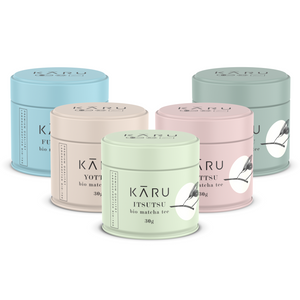
Hitonigiri Organic Matcha Sample Pack (5x30g)
Alle fünf KĀRU Bio-Matchas in einem Set – ideal, um Farbe, Aroma und Geschmack...
99,00 € , 660,00 €/kg


