





Matcha tea is ground, shaded green tea from Japan – when you drink it, you take in the whole leaf instead of just an infusion. Here are the 8 most important facts about matcha tea: from cultivation and production to caffeine and compounds, all the way to flavor, preparation and price.
Key points at a glance
- Matcha is made from tencha: green tea leaves that are shaded for around 2–4 weeks before the harvest. This raises their content of L-theanine and chlorophyll.
- A granite stone mill grinds only about 30–40 g of matcha per hour – the main reason for the high price.
- Depending on the grade, matcha provides up to 44 mg of caffeine per gram; at around 70–80 mg, one bowl (2 g to 80 ml) is roughly equal to an espresso.
- Together with L-theanine, the caffeine works more gently and for longer than coffee – alert, but without the jittery peak.
- The German consumer advice center (Verbraucherzentrale) recommends no more than 1 g per cup, three times a day.
Fact 1: Cultivation
What is matcha made from? Matcha is finely ground Japanese green tea from the Camellia sinensis plant. Its basis is tencha: shaded tea leaves with the stems removed, which after steaming are not rolled but dried and ground into powder. Because the whole leaf stays in the drink, you take in far more compounds than with brewed green tea.
Matcha shares this shaded cultivation with gyokuro – the difference lies in the processing: gyokuro is rolled as a loose-leaf tea, while tencha is ground into matcha. You can read more about origin in our article on the best tea-growing regions in Japan.

Fact 2: Production
How is matcha made? For high-quality matcha, only the top young leaves of the first harvest (ichibancha) are picked by hand. After steaming – which stops oxidation within seconds – the leaves are dried and freed of stems and leaf veins. What remains is pure leaf flesh: tencha.
This tencha is then ground on traditional granite stone mills. The process is deliberately slow to avoid heat: a single mill manages only about 30 to 40 grams of powder per hour. This slowness explains why real matcha takes so much effort and is correspondingly high in quality.
Fact 3: Compounds
What’s in matcha? Because the whole leaf is consumed, matcha is considered one of the most concentrated dietary sources of catechins (especially EGCG). On top of that come chlorophyll, vitamins, minerals and the combination typical of matcha: caffeine and the amino acid L-theanine. You’ll find an overview of the individual compounds in the article on the compounds in matcha.
Fact 4: Caffeine and an alternative to coffee
How much caffeine does matcha have? Depending on the grade and time of harvest, matcha contains about 20 to 44 mg of caffeine per gram. Prepared traditionally with around 2 g of powder to 80 ml, one bowl provides roughly 70–80 mg of caffeine – comparable to an espresso. For comparison: coffee beans usually contain only 10–12 mg of caffeine per gram, and classic brewed green tea comes to around 30 mg per cup.
The key difference is not the amount but the effect: the interplay of caffeine, L-theanine and catechins means the caffeine is absorbed more slowly. Many people experience the energy as steadier and longer-lasting, without coffee’s jittery peak. More on this in the article Matcha as a gentle alternative to coffee.
|
Drink |
Caffeine per serving |
Character of the effect |
|
Matcha (2 g / 80 ml) |
approx. 70–80 mg |
slow, long-lasting, focused |
|
Espresso |
approx. 60–80 mg |
faster, short peak |
|
Filter coffee |
approx. 95 mg |
quick to kick in |
|
Green tea (brewed) |
approx. 30 mg |
mild, short |
Fact 5: Flavor
What does good matcha taste like? High-quality matcha tastes sweet, slightly fruity, sometimes nutty – and always complex. It is marked by a full, creamy mouthfeel and a distinct umami. Good matcha is never strongly sour or harshly bitter. Visually, you can recognize quality by a bright, deep green color; a yellowish or brownish powder points to lower quality or unshaded tea. What else matters when buying is explained in our guide to buying good matcha.

Fact 6: Quality
How do you recognize good matcha? There are very different quality levels on the market. High-quality matcha comes from renowned Japanese growing regions such as Uji, Nishio or Shizuoka, is made from the first harvest and shaded for long enough. Its hallmarks are the deep green color, a sweet, complex aroma and the fine powder. How to classify grades and differences is shown in the article on matcha qualities and differences.
Fact 7: Preparation
How do you prepare matcha tea? For the classic preparation, all you need is a bamboo whisk (chasen) and a bowl. In just a few steps you’ll have a frothy matcha:
Measure
Sift 1–2 g of matcha into the bowl.
Mix
Stir with a splash of water into a smooth paste.
Pour
Add 60–90 ml of water at approx. 70–80 °C.
Whisk
Whisk until frothy with the chasen in W-shaped motions.
Fact 8: Price
Why is matcha so expensive? The price reflects the effort: several weeks of shading with a lower yield, hand-picking of the youngest leaves and slow grinding on stone mills at only 30–40 g per hour. Good matcha can therefore cost €1 per gram or more. Exactly where price differences come from is shown in the article on price differences in matcha.

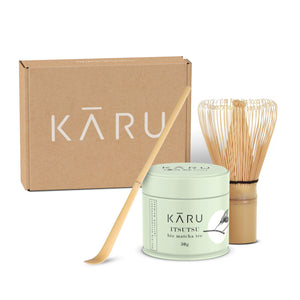
Organic Matcha Itsutsu Mini Set
Ideal für den Einstieg: Bio-Matcha, Bambusbesen und Löffel in einem Set.
29,00 €
Conclusion
Matcha is not an ordinary tea powder, but shaded, carefully ground green tea in which you drink the whole leaf. That explains the intense color, the umami, the comparatively high caffeine content with a gentle effect – and the price. Once you’ve tried good matcha, you taste the difference right away.


