







What does the reference "suitable for koicha" that is so often found in the description of good matcha varieties? What does it mean? koicha or Usucha and how do the two differ? We will answer all these questions in this blog post.
Preparation and consistency - usucha and koicha
Usucha and koicha describe two different ways of preparing matcha tea. While Usucha translates as "thin, light tea", the Japanese refer to Koicha as a "heavy, dark tea". This refers to the intensity or concentration of the tea. When Usucha 60-80 ml water with 1.5 - 2g matcha powder, Koicha requires 20-40ml water 3.5 - 5g of the tea.
Accordingly, the two varieties have a very different consistency. While Usucha has the consistency of a cappuccino or strong espresso, Koicha is more reminiscent of melted chocolate. In addition to the different amounts of powder and water used, the preparation also differs in the way it is stirred. In the case of thin tea, the chasen is stirred in quick w-shaped movements through the bowl to whisk the matcha tea until frothy, koicha is not so much whipped as gently stirred.
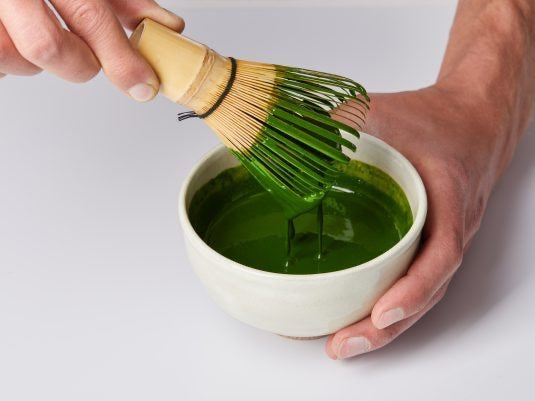
The preparation of the thick tea is therefore very similar to the first phase of classic matcha preparation, in which a homogeneous paste is stirred. You can find a detailed description of the traditional preparation of matcha tea in the blog post: Matcha tea the right way to prepare it. For both variants, however, the temperature of the water should be should never be above 75°Cotherwise you will damage the delicate taste of the tea.
Quality and taste - Usucha and Koicha
Due to the very high concentration of matcha powder in koicha, the flavor is significantly better. more intense than Usucha. All flavors, no matter how subtle, are perceived. This is why the best teas are only tasted as koicha. This makes a precise characterization possible. However, unpleasant notes, such as acidity and increased bitterness, are also perceived more strongly.

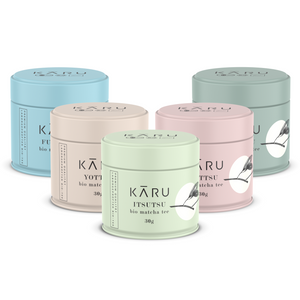
For this reason, we recommend that you only use the highest quality teas to prepare as koicha. Otherwise the bitter notes dominate with cheaper entry-level qualities. Only real premium qualities are also convincing in concentrated form with a sweet and complex character and full umami. For example, our Organic Matcha Hitotsu.
Regardless of this, however, it is a matter of taste whether you prepare your tea with more or less water. While it is customary in Japan to prepare the best varieties as koicha and share a bowl with several people, this is not practiced here. Koicha is still an exception in Europe and even really good teas are mainly prepared as usucha. Such a highly concentrated matcha is also of good quality. a matter of habit.

The right accessories
Besides the Bamboo whisk (Chasen) and the bamboo spoon for correct portioning, the right bowl also supports the two different preparation methods.
The right bowl for usucha
For the preparation of usucha, the thinner and lighter version of matcha, you need wide, shallow tea bowls are best suited. These allow the tea to spread freely and develop its aromas. They also offer enough space to beat the tea properly with the chasen (tea whisk) and create a light, airy layer of foam.
The right bowl for koicha
To prepare koicha, the thick and strong version of matcha, you need deeper and narrower tea bowls are recommended. These maintain the intensity and fullness of flavor, as the tea has less surface area to evaporate.

The quality of the tray is particularly important: it should not only be haptic pleasant, but also visually The tea should also be visually appealing, as the appreciation of the tea is also expressed through the aesthetics of its container.
Usucha and Koicha - The bottom line
As you can see, in addition to the matcha quality used, it mainly depends on your preferences how you prepare your tea. Do you prefer your tea refreshing and light or do you prefer an intense and aromatic paste? Or do you prefer to stick to the non-traditional variant, the matcha latte? We recommend that you don't follow any guidelines, recommendations or names, but instead prepare the tea the way you like it best. So don't follow the "either/or" principle, but simply use different concentrations and compare them with each other to find your personal favorite. As long as the quality of the matcha is right, you can't go wrong.


