







Yoga tips for beginners are rarely about complicated poses – they're about breathing, regularity and three exercises you'll remember quickly. Together with certified yoga teacher Sara Lyn (@saralyn.yoga), we've boiled getting started down to the essentials.
The key points at a glance
- Three exercises are enough to get started: Sethu Bandasana (bridge pose), Anjaneyasana (low lunge) and Virabhadrasana II (warrior II).
- Three sessions a week of 15–20 minutes each do more for beginners than a single long class on the weekend.
- To start, all you need is a non-slip mat and comfortable clothes – at first, a folded towel can stand in for a yoga block.
- Your breath is the steering wheel: if you make the exhale longer than the inhale, you'll stay calmer in demanding poses.
- One serving of matcha (2 g of powder) contains about 40–70 mg of caffeine, depending on the grade, combined with the amino acid L-theanine.
Which yoga exercises are good for beginners?
For getting started, Sara Lyn recommends three poses that together cover the whole body: the back of the body, the hips and standing stability. They can be done without any prior experience and practiced in any home.
All three come from Hatha yoga, the calm, posture-focused foundational style. The photos show them performed correctly – they are taken from the book Hatha Yoga by Martina Mittag (Meyer & Meyer, 2018).
Sethu Bandasana – bridge pose

- Strengthens the shoulders, back, glutes and thigh muscles
- Opens the chest
- Good after a long day at the desk or as a way to open up at the start of the day
Anjaneyasana – low lunge

- Stretches the groin and hip muscles
- Opens the abdominal and pelvic area
- Helps prevent lower back problems in the long run
Virabhadrasana II – warrior II

- Strengthens the ankles, legs, back, shoulders and arms
- Opens the hips and pelvis
- Improves posture and stability
How often and how long should beginners practice?
Regularity beats duration. Three sessions a week of 15 to 20 minutes each build movement patterns more reliably than a single 90-minute class on the weekend, because the body learns through repetition.
In practice, this means: better ten minutes of bridge pose and lunge in the morning than a perfectly planned session that keeps getting canceled. Only increase the duration once the three poses feel familiar.
Arrive
Sit for 2 minutes, observe your breath, don't correct anything.
Practice
The three poses for 5 breaths each, two rounds.
Notice
2 minutes lying on your back, legs long, eyes closed.
What matters when it comes to breathing?
Your breath decides whether a pose feels strenuous or sustainable. Sara Lyn describes yoga as the middle path – the right balance between effort and relaxation. A deep breath helps you stay present.
A concrete guide: breathe in for four seconds and out for six. As soon as you hold your breath in a pose, it's too demanding – take a step back instead of pushing through.
How do matcha and yoga go together?
Both follow the same logic: focused, but unhurried. We've described this in detail in our article on sports and matcha.
The reason lies in the composition. Matcha provides caffeine together with the amino acid L-theanine, which occurs almost exclusively in the tea plant Camellia sinensis. In a double-blind study by Giesbrecht et al. (2010, Nutritional Neuroscience), the combination of 97 mg of L-theanine and 40 mg of caffeine improved task-switching accuracy and self-rated alertness in 44 young adults. So studies suggest that this combination works differently than caffeine alone.
|
Drink |
Caffeine per serving |
What's special |
|
Matcha (2 g) |
approx. 40–70 mg |
With L-theanine: the whole leaf is drunk as a powder – caffeine and amino acid work together |
|
Drip coffee (200 ml) |
approx. 80–100 mg |
Without L-theanine: the caffeine works on its own and therefore feels more direct to many people |
|
Loose-leaf green tea (infusion) |
approx. 20–30 mg |
Infusion only: the leaf stays in the pot – correspondingly less caffeine per cup |
In terms of timing, a bowl about 30 minutes before your practice works well: the caffeine kicks in without a full stomach getting in the way of forward bends. If you practice in the evening, it's better to skip it.

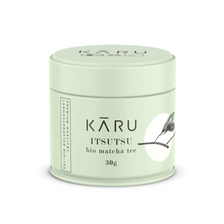
Organic Matcha Itsutsu
Sanftes Koffein für ruhigen Fokus – vor oder nach der Praxis.
from 19,00 € , 633,33 €/kg
Conclusion
Three poses, three short sessions a week, a calm breath – that's all you need to get started. You'll find more detailed descriptions and further exercises on Sara Lyn's blog at saralyn.de.
Frequently asked questions
Wie oft sollte ich als Yoga-Anfänger üben?
Brauche ich als Yoga-Anfänger spezielle Ausrüstung?
Wann trinke ich Matcha am besten – vor oder nach dem Yoga?
Was tun, wenn ich beim Yoga unbeweglich bin?
Photos from the book Hatha Yoga by Martina Mittag, published in 2018 by Meyer & Meyer.


