





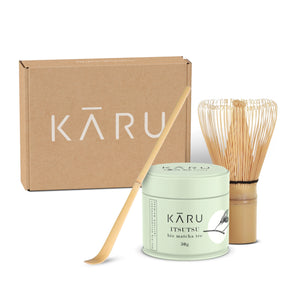
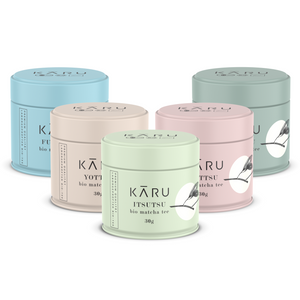


You may have noticed that your favorite matcha is sometimes sold out or not immediately available. You’re not alone—matcha is currently in short supply worldwide. Here at Kāru, we’d like to explain transparently why matcha is harder to come by right now, what’s behind this global shortage, and what’s next.
The Global Matcha Boom
In recent years, matcha has evolved from a niche product into a global trend. Matcha lattes, matcha cookies, or matcha tiramisu—social media, TikTok videos, influencers, and growing health awareness have made this green tea popular all over the world, especially in Europe and Germany. For many, matcha or a matcha latte in cafés has long since become a healthy alternative to coffee. Due to the huge hype, demand has grown faster than the tea fields can keep up.

Between 2023 and 2028 alone, the global market for matcha powder is expected to grow from around 2.8 billion U.S. dollars to about 5 billion U.S. dollars, which shows just how many people worldwide are discovering matcha for themselves and how rapidly its popularity continues to rise.
Why Matcha Tea Can’t Simply Be “Mass-Produced”
High-quality matcha powder is not a mass-produced product. It is made in Japan from shaded, young tea leaves and ground on granite stone mills according to Japanese tradition—a process that requires time, experience, and deep knowledge of the centuries-old matcha culture. This means that manufacturers cannot simply “quickly” produce matcha in large quantities when global demand skyrockets.
Japanese tea companies have indeed increased matcha production—in 2023, 4,176 metric tons of tencha (the base for green tea powder) were harvested, nearly three times as much as in 2010. But these quantities aren’t enough to satisfy the global appetite for matcha.

On top of that, the best tea leaves for matcha are harvested only once a year, in the spring. Newly planted tea bushes take about five years before they can produce high-quality matcha. These natural limitations mean that matcha will always remain a valuable product that requires time and care. Furthermore, organic matcha is a rare commodity from its country of origin, Japan. Only a single-digit percentage of total matcha production is certified organic. This explains why organic-quality matcha is often even harder to find—especially as global demand rises and exports from Japan are limited.
Climate and Harvest Affect Availability
Matcha is a natural product that is highly dependent on the weather. Climate change and unpredictable weather conditions have recently had a significant impact on Japan’s tea-growing regions—extreme weather events have led to lower yields and further restricted supply. As a result, the 2025 matcha harvest in Japan is considered by some to be the worst in 25 years, which has exacerbated the shortage and further strained the market situation. At the same time, global demand for high-quality matcha has risen rapidly in recent years, causing the gap between supply and demand to widen even further.

An example of the current market pressure can be seen at the tea auctions in Kyoto: In the spring of 2025, there was intense competition there for the best tea leaves, as many producers sought to secure the highest-quality batches. This competition illustrates just how intense the pressure on the matcha market is right now.
What does the matcha crisis mean for you?
All these factors mean that matcha is becoming harder to find at times:
-
High global demand meets limited supply.
-
Matcha cannot simply be produced any faster.
-
Weather and climate directly affect harvests.
-
Japan now exports more than half of its matcha abroad.
As a result, your favorite variety may be temporarily sold out or it may take a little longer for new shipments to arrive from Japan. We want to let you know: If matcha isn’t immediately available, it’s because quality and careful production take time.

How we handle this at Kāru
Here at Kāru, we’ve been working directly with family-run businesses and tea farms in Japan since 2017 to source high-quality, authentic matcha under fair conditions—even when it’s more challenging. Thanks to our long-standing relationships and experience, we’re able to secure sufficient stock this harvest season and keep our warehouse well-stocked, even though available inventory is currently lower than usual.
This way, we ensure that your matcha remains traceable from harvest to your cup, so you can consciously enjoy its unique flavor.
If your favorite variety isn’t available right now, it’s worth trying other varieties—each harvest has its own character and can enrich your matcha moment. We’ll continue to keep you informed honestly and transparently if there are any delays, and we thank you for being part of the Kāru community and for consciously enjoying matcha.
Stay curious and savor every sip of matcha—it’s more precious now than ever.


